If You're Meeting a New Doctor for the First Time, What Are Your Non-Negotiables?
I was at an event last night, and someone asked a question that completely stopped the room.
It was one of those moments when everyone went quiet because they realized they’d been thinking the exact same thing for years but had never once said it out loud.
The question was this: What are your non-negotiables when you see a new doctor?
And I thought, oh. We are doing this. We are actually talking about this.
Because here is what I know to be true: Most of us have a whole internal list. We weigh it, we debate it, we talk ourselves out of it, and then we walk into that exam room and just passively answer whatever we're asked. We hand over our power before we even sit down.
I am not doing that anymore. And I don’t want you to do it either.
If I am meeting a new doctor for the first time, here is what I blankly refuse to compromise on:
1. I need to feel heard before anything else.
Not just listened to. Heard. There is a massive difference. I’ve sat in rooms where the doctor is already typing before I’ve even finished my sentence. And now, there’s a new layer: doctors asking, "Do you mind if I record this session with AI?"We are really living in this moment right now! While it’s not necessarily a bad thing, it forces us to ask: what does true human connection look like when there’s a third party, even a digital one, in the room?
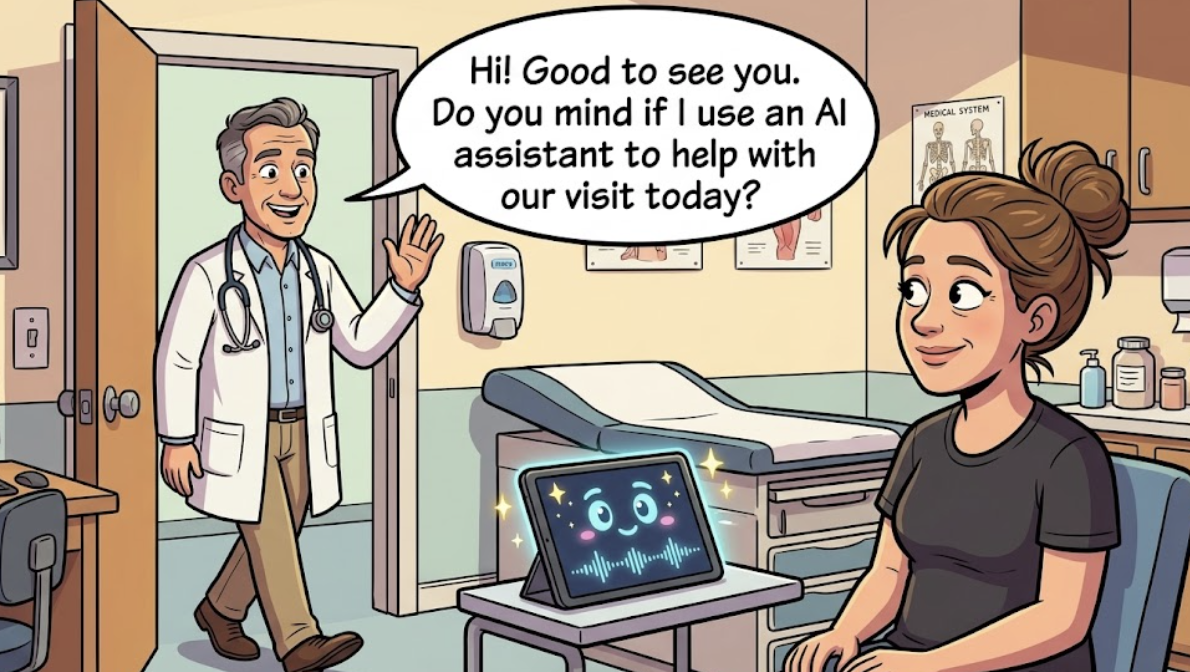
2. I need them to see me, not a chart.
As a dietitian with nearly 30 years of experience, I have spent decades watching what happens when a human being's lived experience gets reduced to a number on a scale or a label on a lab report, and I do not want to be rushed. The way a doctor responds to my body, my history, and my concerns tells me everything I need to know about whether we can actually partner together.
3. I need to trust that the plan fits my life.
If I need a scan, a surgery, or a medication, I need to know the plan was built with me in mind. Not the "average" patient. Me. Because when there is a misalignment between you and your provider, human nature takes over: you stop following through. You skip the medication. You blow off the follow-up. Not because you’re a "bad patient," but because something in the relationship feels wrong. And the body keeps score.It always does. Alignment isn't a luxury in medicine; it’s part of the treatment.
Standing Your Ground (and Monique's Story)
Advocating for yourself isn't being difficult. It's being present in your own care. If it’s Friday and I have a sinus infection, I am not waiting until Monday. If a doctor says "let’s wait and see" on something my gut disagrees with, I will say so. Calmly, but clearly, I am the one who doesn’t feel well. 😳
So many people are suffering quietly with urinary tract health, menopause, andropause, and hormone imbalances because they don’t think they’re allowed to ask more questions or find a specialist who actually sees them.
Take my client Monique (name changed for privacy). At 57, this brilliant, dedicated career woman had her life turned completely upside down by her gut health. She was suffering so severely that she couldn't even go into the office anymore. When she came to me, she was defeated and deeply embarrassed, which broke my heart, because none of this was her fault. Maybe even gaslight.
Her doctor had actually diagnosed her with SIBO (Small Intestinal Bacterial Overgrowth), which had flared up after a heavy course of antibiotics and just kept recurring. That cycle was driving months of severe gastric distress and scary weight loss. Her doctor gave her my name, she called my assistant, and we got her in for an emergency consultation right away. The very first thing I told her was: "I've got you. We are going to figure this out." A big sigh of relief was had.
We met over Zoom and put a targeted plan into action. At each meal, Monique took an enhanced supplement protocol of Berberine and Undecylenic Acid to aggressively address the bacterial overgrowth while supporting her blood sugar regulation. I always tell my clients that results can take anywhere from 3 days to 3 weeks. For Monique, around day ten, the shift happened. The chronic distress began to clear. She started feeling like herself again.
What We Used: If you are dealing with similar gut distress, you can find the exact, professional-grade Berberine Supplement and Undecylenic Acid Supplement we used to get her life back.
The Takeaway
Your inner dialogue in that exam room matters. Pay attention to it.
You are allowed to have non-negotiables. You are allowed to trust your instincts. You are allowed to ask why, ask how, and ask what a diagnosis means for you specifically. You are allowed to fire a team member who doesn't fit.
If you’re not sure where you stand right now, start by noticing how you feel when you walk out of an appointment. Do you feel clearer or more confused? More supported or more dismissed?
That feeling is data. Use it.
Your relationship with your body is the longest relationship of your life. Choose your team accordingly.
With love,
Kim ❤️
Curious about working together? Let's get you feeling like yourself again. Book a FREE 10-Min Discovery Chat so we can map out a plan that actually fits your life.
