The Credibility Crisis and Why Your Intuition Is Being Drowned Out
When you are on social media, what you see on your screen is a crop. It is a tiny, well-lit sliver of a much messier reality. In my 29 years as a Registered Dietitian, I’ve seen that the same is true for the nutrition advice being pushed in that frame.
If I were standing in your shoes today, looking for help, feeling overwhelmed, and trying to heal your relationship with food: I would be terrified. I’ve spent nearly three decades in the trenches of human nutrition. I’ve seen the low-fat craze, the no-carb craze, and every "miracle" supplement in between. My mission has always been simple: helping you become a "Normal Eater." That is someone who eats when they’re hungry, stops when they’re full, and doesn't let food run their life.
But today, that mission is under fire. We are living through a Nutrition Credibility Crisis, which is creating a dangerous paradox affecting your health and your peace of mind.
1. The "Yellow Journalism" of Nutrition
You’ve seen the headlines: "This one food adds 33 minutes to your life!"or "Common vegetable causes instant inflammation!" This is what we call Yellow Journalism. It is sensationalized, exaggerated reporting that picks "clicks" over "clinical facts."
These headlines are designed to create Unnecessary Fear. One of the biggest myths I see is the idea that "Organic" is a magic shield. Influencers claim organic food is free from "pollution," but the scientific reality is that organic crops grow in the same soil as everything else. If environmental pollutants have impacted the soil over decades, a label will not magically filter that out. When influencers simplify this, they create a false sense of security that hits your wallet without necessarily helping your biology.
2. The "Forever Size 1" Vibe
What scares me most as a professional is that an algorithm knows what you click on, but it doesn’t know you. When a creator gives a "one-size-fits-all" prescription to millions of strangers, it reminds me of a story about my sister.
When we were kids, she always disliked a certain shop because the name sounded to her like "Forever Size 1." That is exactly the vibe of social media nutrition today. They are trying to sell you a "Forever Size 1" philosophy: one size, one way, one result. But life doesn't work that way, and your body certainly doesn't. If a piece of clothing doesn't fit, you don't blame your body; you change the clothes. So why, when a "one-size-fits-all" diet fails, do we blame ourselves?
As I always say: "If they haven't seen your history, they shouldn't be making your future."
3. The Solution: Six Simple Rules®
I am not against influencers at all; I love the inspiration they provide! But I want you to have clinical guardrails. I believe the future of health is Collaboration: where creators work alongside credentialed clinicians who are professionally educated and retrained year after year with hundreds of hours of clinical study. This allows each of us to deliver the proper care and the inspiration you want and need, while ensuring the safety you deserve.
Here is another reason why I developed The Kim Shapira Method®. These are not rules to restrict you; they are tools that allow you to stop listening to the noise and start listening to your body's wisdom.
To drown out the noise, we use these Rules#:
Eat only when you're hungry (start with half and wait 15 minutes to see if you need more).
Eat what you love.
Eat without distraction.
10,000 steps daily.
8 cups of water daily.
Sleep 7 hours nightly.
If you’re done with the noise and ready for a change. "The Six Simple Rules are just the beginning. Whether you need a self-paced deep dive or one-on-one clinical support, I have a path designed for your biology."
Be well,
Kim Shapira, M.S., R.D. Founder, The Kim Shapira Method™
Check out some tools I have for you-
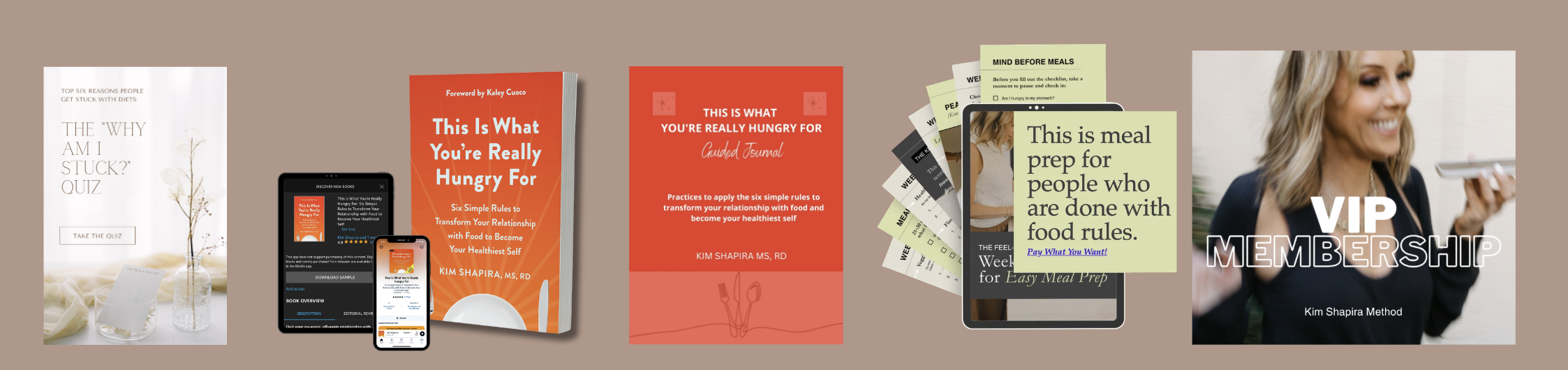
Each tool In this toolbox opens a pathway just for you
Whatever it is, you get to identity and transform your relationship with food going forward.
📖 Get the Book: This Is What You're Really Hungry For
📓 Grab the Original KSM Wellness Journal (partner to the book)
✅ Download The Feel-Good Food Flow (Weekly Meal Prep Checklist)
